


Mosques in Turkey to Visit


Introduction
Turkey, formally the Republic of Türkiye, is a transcontinental nation with the majority of its territory in Western Asia's Anatolian Peninsula and a tiny section in Southeast Europe's Balkan Peninsula. The Religious Affairs Directorate reports that there are 82,693 mosques in Turkey, with Istanbul housing the majority of them. There are 3,113 mosques in Istanbul, including the well-known Sultanahmet Mosque and the Süleymaniye Mosque. Some of the most well-known mosques are open for visits, although not all 82,693 of them. We will read about some of Turkey's most popular mosques in this article today. You can obtain your Turkey visa through e-turkeyvisa.
READ ALSO: BEST PLACES TO VISIT IN ANKARA TURKEY
Some Must-Visit Mosques Are
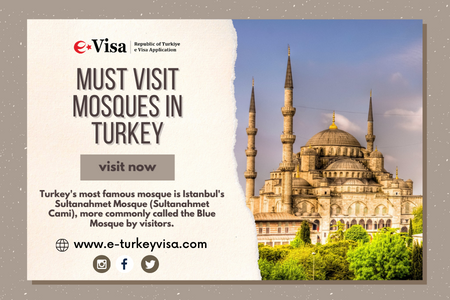
Blue Mosque
Sultan Ahmet, I (reigned 1603–1617) had the mosque constructed by Ottoman architect Sedefkâr Mehmet Aa as a symbol of Ottoman imperial sovereignty. It had a contentious six-minaret design. 21,000 Iznik tiles are used to embellish the vast prayer hall's interior. The mosque was given its name because the blue tile was frequently utilized in its design.
Suleymaniye Mosque
The prayer hall's enormous dome interior, along with its Iznik tile mihrab, stained-glass windows, and intricately carved woodwork features, give it a more tranquil interior atmosphere than the more recent mosque down the hill, despite the Blue Mosque being more popular with tourists. Visitors can experience how the city's vast Ottoman mosques would have operated in the imperial heyday by seeing the surrounding structures of the ancient mosque complex, which have all survived and been restored.
Rustem Pasa Mosque
Even though it lacks the impressive architectural scale of Istanbul's most well-known imperial mosque constructions, a visit here is a must if you want to see the amazing Iznik tile work up close. The mosque's interior and exterior walls are both embellished with Iznik tile panels with floral and geometric patterns. The mosque is on a more human scale, making it easier to observe the intricate artwork without being overwhelmed by the size and quantity of tile work.
READ ALSO: REASON FOR TURKEY VISA REJECTION
Sultan Beyazit II Mosque
The Sultan Beyazt II Mosque (Sultan Beyazt II Cami) in Amasya has been standing in the middle of the city, looking out over the Yeşilrmak River, since 1486. Pay note to the ablution fountain in the front courtyard before you enter the mosque. Its roof is embellished with beautiful Amasya murals. The prayer hall's interior features an especially elaborate wood carving and a white marble mihrab, but it is more stunning for the spacious, soaring double-domed interior's sense of sophistication.
Bursa Grand Mosque
Bursa, the first Ottoman capital, is home to an abundance of early Ottoman buildings. The Grand Mosque (Ulu Cami), the most famous structure in the city, is located in the centre of the city and is surrounded by a sizable bazaar area filled with beautifully renovated hans (caravanserais), which are a remnant of Burma's former prominence as a major trading hub. The sultan's overly ambitious promise to erect 20 mosques following his victory over the Crusaders led to the development of this architectural feature. Instead, he created a single mosque with that many domes.
Mehmud Bey Mosque
One should make a special journey here if they are interested in the artistic design of mosque interiors. The interior of this modest mosque, which is located in the hamlet of Kasaba, 17 kilometres from the city of Kastamonu, is one of the outstanding examples of painted-wood mosque interiors still in existence in Turkey. It was constructed in 1366. Beautiful floral and geometric painted designs in fading but typically well-preserved patterns cover the wooden interior's ceiling, columns, and ornately carved wooden gallery. The inside woodwork was constructed using an interlocking wood joint technique known as kundekari in Turkish, all without the use of nails.
READ ALSO: VISIT VISA FOR TURKEY
Muradiye Mosque
In the town of Manisa, where he had previously served as governor, Sultan Mehmed III ordered the construction of this mosque after seizing control of the Ottoman Empire (1595–1603). Sultan Mehmed was Sultan Selim II's son. Renowned architect Sinan designed the Muradiye Mosque (Muradiye Cami), which was built by his father and grandfather before him. It is renowned for its extensive use of fine Iznik tile work throughout the interior, especially the tiled mihrab, which is all illuminated by stained-glass window details.
Sakirin Mosque
Turkey has many contemporary mosques, however, almost all of them have Ottoman architectural features. One of the best sites to go to see a mosque that rejects conventional style is the kirin Mosque (akin to Cto ami), which is located in the Üsküdar area of Istanbul. A completely modern and distinctive mosque was designed by interior designer Zeynep Fadllolu and architect Hüsrev Tayla, and it was built in 2009. Screens made of ornamental metal soften the exterior's stark, minimalist design of stone and aluminium. Don't overlook the ablutions fountain in the courtyard with its central grey metal dome that reflects the mosque facade.
READ ALSO: TOURIST ATTRACTIONS IN ANTALYA
Conclusion
This article was about some must-visit mosques in Turkey and has all the related information about them. In this article, we have selected some most famous mosques in Turkey and you can visit these mosques without a doubt. Every year thousands of visitors visit Turkey and it is also not difficult to obtain a Turkey visa as you can obtain it through e-turkeyvisa.
Was this article helpful?
Thanks — that helps us write better guides.


Frequently asked questions
Islam is the most common religion in Turkey. More than 99 percent of people are Muslims, and the bulk of them are Sunnis. Judaism and Christianity (Oriental Orthodoxy, Greek Orthodoxy, and Armenian Apostolic) are other religions that are practiced, but non-Muslim populations began to diminish in the early 2000s.
-
 Tourist Visa
turkey-portal-move-2026-09-23
0 comments
3 views
Tourist Visa
turkey-portal-move-2026-09-23
0 comments
3 views
Best Hiking Trails in Turkey
Do you want to visit the amazing trekking trails of Turkey? Imagine the soul-pleasing scenery you will be… -
 Tourist Visa
turkey-portal-move-2026-09-23
0 comments
5 views
Tourist Visa
turkey-portal-move-2026-09-23
0 comments
5 views
Most Picturesque Locations in Turkey
Are you intrigued by the wonderful and breathtaking scenic sites of Turkey? Turkey has a lot of adventures,… -
 Tourist Visa
turkey-portal-move-2026-09-23
0 comments
4 views
Tourist Visa
turkey-portal-move-2026-09-23
0 comments
4 views
Turkey Visa for Tanzania Nationals
In this article, you can find all the relevant information related to turkey visas for Tanzania nationals.…


Comments
0No comments yet. Be the first to ask a question.